Guide to Industrial Marble Cutting Machines and Processes
Industrial marble cutting combines mechanical cutting, computer-controlled movement, water management, and finishing techniques to transform large marble slabs or blocks into accurately sized components.
Industrial marble cutting machines range from bridge saws and CNC cutting centers to waterjet systems designed for curved and detailed shapes.
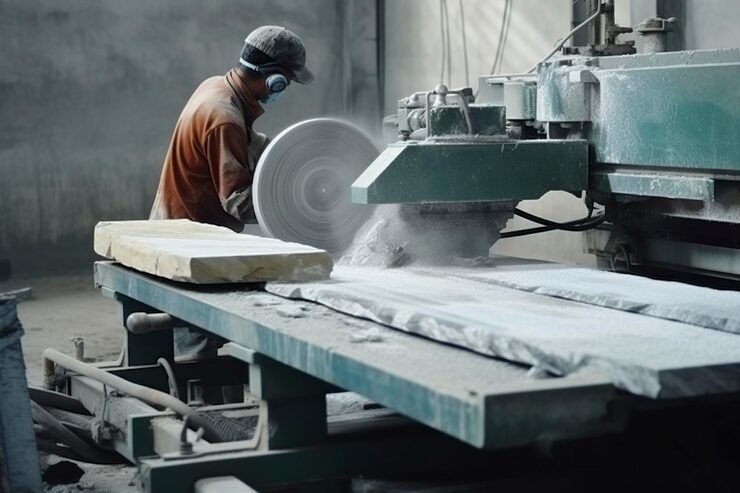
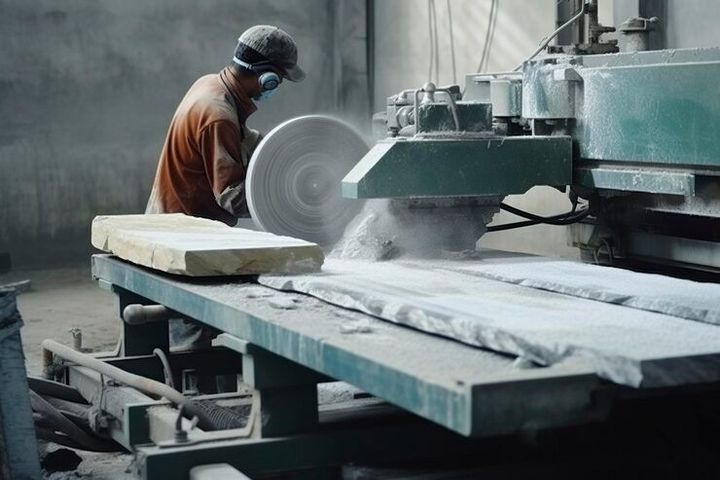
The cutting process depends on marble thickness, hardness, slab dimensions, required geometry, and the intended application. Modern systems increasingly use CNC controls, digital templates, automated positioning, and water-based dust suppression to improve consistency while helping manage workplace hazards.
Context
Marble is a natural stone composed mainly of recrystallized carbonate minerals. Its appearance, grain structure, hardness, and internal characteristics can vary from one slab to another. These variations influence how a marble cutting machine should be configured and operated.
Industrial marble cutting generally begins with slab inspection and measurement. The material is then positioned securely on a cutting table. Depending on the required shape, a diamond blade, CNC tool, or high-pressure waterjet is used.
Common industrial marble cutting machines include:
| Machine type | Main function | Typical applications |
|---|---|---|
| Bridge saw | Straight and angled cuts | Slabs, tiles, countertops |
| CNC bridge saw | Programmable multi-axis cutting | Complex profiles and repeated shapes |
| Waterjet cutter | Curves and intricate patterns | Inlays, mosaics, decorative work |
| CNC stone router | Shaping, drilling and profiling | Edges, openings and detailed profiles |
| Wire saw | Large blocks and thick sections | Block and architectural stone processing |
Diamond tooling is widely used because diamond abrasives can cut hard stone efficiently. Water is commonly applied during cutting to cool the blade, control airborne particles, and carry away some cutting residue.
A typical industrial process can include:
- Slab inspection and digital measurement
- Cutting-plan preparation
- Material positioning and securing
- Primary straight or shaped cutting
- Edge profiling or drilling
- Surface finishing
- Cleaning and quality inspection
Waterjet systems can be particularly useful where the cutting pattern includes curves, internal openings, or intricate designs. CNC bridge saws can combine programmed movement with angled cutting capabilities, allowing several operations to be coordinated through digital controls.
Importance
Industrial marble cutting affects stone processors, architectural manufacturers, construction projects, interior applications, monument production, and workers operating or maintaining cutting equipment.
Accuracy is important because an incorrect cut can affect assembly, edge alignment, joints, and the appearance of a finished architectural component. Consistent cutting also helps manufacturers work with different slab dimensions and complex designs.
Worker safety is another major consideration. Cutting, grinding, drilling, and polishing stone can generate respirable crystalline silica when silica-containing materials are processed. OSHA identifies stonecutting as an activity that can create respirable crystalline silica exposure, which can cause serious occupational diseases.
Water-based cutting methods can substantially reduce airborne dust. OSHA's construction standard specifically identifies stationary masonry saws and other applicable cutting equipment with continuous water delivery as engineering controls for qualifying silica-generating tasks.
Effective workplace planning therefore considers both cutting accuracy and exposure control. Equipment should be operated according to its manufacturer's instructions, with suitable guarding, water delivery, ventilation, housekeeping, and personal protective measures where required.
Recent Updates
From 2024 through 2026, industrial stone processing has continued moving toward greater digitalization and automation. Five-axis CNC bridge saws, combined saw-and-waterjet systems, digital templating, automated slab positioning, and camera-assisted measurement are increasingly represented in modern equipment designs. Industry equipment documentation from this period shows the integration of CNC control, digital templates, vacuum handling, slab imaging, and automated cutting functions.
Digital Cutting and Automation
Modern CNC systems can receive CAD drawings and convert them into programmed cutting paths. Five-axis movement can support angled cuts, curved profiles, sink openings, bevels, and other geometries without requiring every operation to be performed manually.
Combined sawjet systems are another development. These systems use a bridge saw for suitable straight cuts and a waterjet for curves or detailed shapes. The combination can reduce the need to move a slab between separate cutting systems.
Digital templating is also becoming important. Measurements can be converted into digital files that can then be incorporated into CAD/CAM workflows. Some newer systems also use cameras and slab imaging to help operators position patterns more accurately.
Environmental and workplace controls are receiving increased attention as well. A February 2026 OSHA/NIOSH hazard alert specifically updated guidance for workers involved in natural and engineered stone countertop manufacturing, finishing, and installation. It emphasizes controlling respirable crystalline silica exposure through appropriate engineering and work-practice controls.
Another developing area is the management and potential reuse of stone-cutting slurry. Research published in 2024 examined computational approaches for developing applications for marble sludge, reflecting broader interest in reducing waste from stone processing.
Laws or Policies
Requirements for industrial marble cutting depend on the country, state, workplace classification, and material being processed. Businesses should consult the applicable occupational safety, environmental, machinery, and waste-management authorities before establishing or modifying a cutting operation.
In the United States, OSHA's respirable crystalline silica standards cover relevant construction and general-industry activities. The standards emphasize engineering and work-practice controls, including wet methods and local exhaust ventilation. They also restrict dry sweeping and dry brushing where these practices could contribute to silica exposure when safer feasible alternatives exist.
In India, the Occupational Safety, Health and Working Conditions Code, 2020 became effective on November 21, 2025. The Ministry of Labour and Employment also lists the Occupational Safety, Health and Working Conditions (Central) Rules, 2026. These developments are relevant to workplace safety obligations for covered establishments.
Environmental requirements can also apply to industrial stone-processing facilities. In India, the Central Pollution Control Board describes the Air (Prevention and Control of Pollution) Act, 1981 as a framework for preventing, controlling, and reducing air pollution, with State Pollution Control Boards playing important implementation roles.
For equipment placed on the European market, Regulation (EU) 2023/1230 establishes a newer machinery-safety framework. Its general application date is January 20, 2027, with some provisions applying earlier.
Tools and Resources
Several resources can help people understand industrial marble cutting processes and workplace requirements.
Useful resources include:
- OSHA silica standards and workplace guidance for exposure-control information.
- NIOSH publications for research and practical information about stone-processing hazards.
- India's Ministry of Labour and Employment resources for occupational safety legislation and rules.
- CPCB resources for environmental and air-pollution regulations in India.
- CAD/CAM software for creating cutting layouts and CNC toolpaths.
- Digital measuring and templating systems for transferring dimensions into machine-readable designs.
- Manufacturer manuals for blade specifications, water flow, machine setup, maintenance, and safety procedures.
When evaluating a cutting workflow, useful technical information includes maximum slab dimensions, cutting depth, axis configuration, blade diameter, spindle characteristics, water-management arrangements, CNC compatibility, positioning accuracy, and available safety controls.
Maintenance records are also useful. Operators can document blade condition, water flow, filter status, slurry accumulation, machine alignment, calibration, and inspection results. These records can help identify recurring operational problems before they affect cutting quality.
FAQs
What is an industrial marble cutting machine?
It is equipment designed to cut, shape, or profile marble slabs, blocks, and components at an industrial scale. Common types include bridge saws, CNC machines, waterjets, and stone routers.
Which machine is suitable for straight marble cuts?
Bridge saws are commonly used for straight cuts. CNC bridge saws add programmable movement and can support angled or more complex cutting operations.
Why is water used during marble cutting?
Water can cool the cutting tool, reduce airborne dust, and help carry cutting residue away from the cutting area. Proper water delivery is also an important engineering control for applicable silica-generating operations.
Can CNC machines cut complex marble shapes?
Yes. Multi-axis CNC systems can produce angled cuts, profiles, openings, and other programmed geometries. Waterjet systems can also handle many curved and intricate patterns.
What is the main safety concern when cutting stone?
One important concern is exposure to respirable crystalline silica generated during cutting, grinding, drilling, and similar processes. Appropriate engineering controls, housekeeping practices, training, and protective measures should be based on the applicable regulations and workplace exposure assessment.
Conclusion
Industrial marble cutting combines diamond tooling, water management, CNC control, measurement systems, and finishing processes to produce accurately shaped stone components. Recent developments from 2024–2026 show continued movement toward five-axis cutting, digital templating, automation, integrated sawjet systems, and stronger attention to dust-control practices.
For a safe and consistent workflow, operators need to consider the marble characteristics, machine capabilities, cutting geometry, water and dust controls, maintenance requirements, and applicable regulations. Current occupational-safety and machinery rules should always be checked for the specific country and workplace.
Understanding the complete process helps users distinguish between basic bridge-saw cutting, advanced CNC processing, and waterjet applications. It also makes it easier to plan appropriate measurement, cutting, finishing, inspection, and environmental-control procedures.