Atlas Copco Guide: Explore Industrial Equipment, Compressed Air Systems, and Modern Technology
Atlas Copco is an industrial technology company associated with compressed air systems, vacuum equipment, industrial tools, and specialized equipment used in manufacturing and other industrial operations.
Understanding its technologies helps readers learn how industrial machinery supports production, energy management, and automated processes.
This Atlas Copco guide explains compressed air systems, industrial equipment, modern technologies, safety considerations, and relevant regulations. It is intended for students, engineers, technicians, facility managers, and general readers interested in industrial machinery and its applications.
Context – Understanding Atlas Copco
Atlas Copco is a Swedish industrial group founded in 1873. Over time, the company expanded from its early industrial engineering activities into several areas of equipment and technology. Its operations include compressed air, vacuum technology, industrial assembly solutions, and equipment used in selected manufacturing and construction applications.
Compressed air is one of the most important technologies associated with Atlas Copco. It involves using mechanical equipment to compress atmospheric air, store or condition it when required, and distribute it to tools, machinery, or industrial processes.
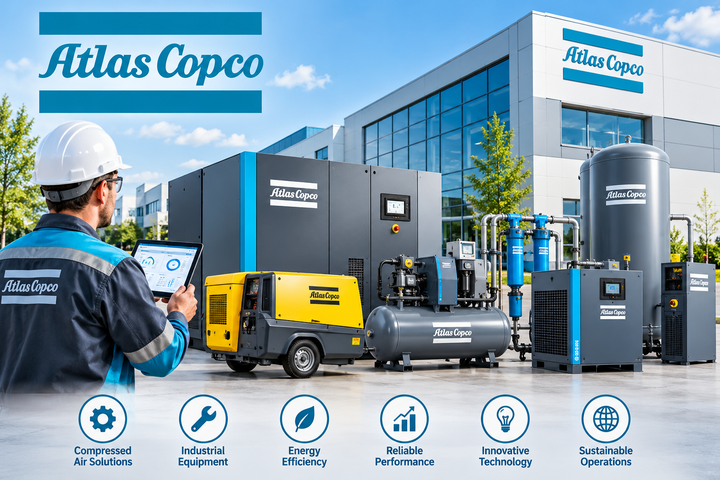
Compressed air systems may include compressors, air receivers, dryers, filters, piping, pressure regulators, and monitoring equipment. Each component performs a different function within the overall installation.
| Equipment category | Main purpose | Common applications |
|---|---|---|
| Air compressors | Increase air pressure | Manufacturing, workshops, pneumatic equipment |
| Air dryers | Reduce moisture in compressed air | Electronics, production lines, industrial processes |
| Air filters | Remove specified contaminants | Instrument air and sensitive equipment |
| Vacuum pumps | Create and maintain vacuum conditions | Packaging, material handling, laboratories |
| Industrial assembly tools | Perform controlled fastening and assembly | Automotive and manufacturing facilities |
| Portable compressors | Supply compressed air at different locations | Construction, infrastructure, field operations |
| Monitoring systems | Measure operating conditions and performance | Maintenance and energy management |
The correct equipment configuration depends on the required air pressure, flow rate, air quality, operating environment, and duty cycle. A system designed for a small workshop may differ substantially from one used in a large manufacturing facility.
Importance – Why Industrial Equipment Matters
Industrial equipment supports the operation of factories, workshops, processing facilities, construction projects, and other technical environments. Compressed air can power pneumatic tools, operate actuators, move materials, and support production processes.
Equipment selection and system design affect productivity, reliability, maintenance requirements, and energy consumption. Compressed air generation can require substantial electricity, particularly when systems operate continuously or have leaks and inefficient pressure settings.
Several factors influence industrial performance:
Air demand: The required volume of compressed air varies according to the number and type of connected machines.
Operating pressure: Equipment must receive suitable pressure without unnecessary increases that raise energy demand.
Air quality: Moisture, oil, and particles must be controlled according to the process requirements.
Maintenance: Filters, dryers, compressors, and piping need appropriate inspection and upkeep.
Monitoring: Pressure, temperature, flow, and energy measurements help identify operating problems.
Compressed air is not always the most energy-efficient method of powering a process. Electric motors or other technologies may be more suitable for particular applications. Comparing the complete system requirements helps engineers make informed technical decisions.
Industrial vacuum technology is also important. Vacuum pumps remove gas from an enclosed space to achieve a required pressure level. These systems are used in packaging, material handling, semiconductor production, and scientific applications.
Recent Updates – Industrial Technology and Modern Developments
Industrial equipment continues to evolve through digital monitoring, automation, energy-efficiency improvements, and more advanced maintenance methods. These developments are relevant to compressed air systems and other industrial machinery.
One major trend is connected equipment monitoring. Sensors can collect information about pressure, temperature, vibration, operating hours, and energy consumption. Software can use this information to identify abnormal conditions and help maintenance teams investigate potential faults.
Predictive maintenance uses equipment data and operating patterns to estimate when a component may require attention. It can help organizations plan inspections, although predictions depend on data quality, system design, and appropriate technical interpretation.
Another important development is variable-speed compressor technology. These systems adjust motor speed in response to changing air demand, potentially reducing energy consumption when demand varies. Actual performance depends on the compressor design, operating range, installation, and overall system conditions.
Heat recovery is also relevant. Compressing air generates heat, and some systems can capture part of that heat for appropriate industrial or building applications. The practical value depends on temperature requirements, operating schedules, and installation design.
Other developments include:
Improved monitoring of compressed air leaks.
Digital tools for tracking equipment condition.
More efficient industrial vacuum systems.
Automated assembly tools with process monitoring.
Integration of industrial equipment with factory control systems.
These technologies do not automatically improve every installation. Their results depend on correct sizing, commissioning, maintenance, and the conditions under which equipment operates.
Laws or Policies – Industrial Safety and Environmental Requirements
Industrial equipment must comply with applicable safety, environmental, electrical, and pressure-system requirements. The specific rules depend on the country, equipment category, installation, and intended use.
In the European Union, applicable machinery safety legislation and pressure-equipment requirements may affect equipment design, conformity assessment, documentation, and use. Regulation (EU) 2023/1230 on machinery establishes a new EU machinery framework, with its general application scheduled for 20 January 2027. Other applicable requirements may continue to govern equipment during the transition.
In the United States, the Occupational Safety and Health Administration (OSHA) establishes workplace safety requirements. Relevant rules may address machine guarding, hazardous energy control, electrical safety, and compressed air use. Pressure vessels and air receivers may also be subject to applicable standards and inspection requirements.
In India, industrial installations may be affected by the Factories Act, 1948, applicable state factory rules, occupational safety requirements, electrical regulations, and relevant pressure-vessel or boiler provisions. The applicable legal framework should be verified against current legislation and the specific equipment classification.
Industrial operators should pay attention to:
Pressure ratings and approved operating limits.
Appropriate machine guards and emergency controls.
Safe isolation before maintenance.
Inspection of air receivers and pressure-related components.
Noise exposure and workplace ventilation.
Applicable environmental and energy-efficiency requirements.
Equipment manuals, technical documentation, and local regulations should be consulted before installation or modification. Maintenance personnel should follow established safety procedures rather than relying on general descriptions alone.
Tools and Resources – Learning About Industrial Equipment
Understanding industrial equipment requires knowledge of machinery specifications, system performance, maintenance procedures, and safety requirements. Technical documentation and measurement tools help users evaluate these areas.
Useful resources and tools include:
Equipment manuals and technical datasheets for operating limits, installation requirements, and maintenance schedules.
Compressor sizing calculations to estimate required air flow and operating pressure.
Air-quality specifications to determine suitable filtration and drying requirements.
Pressure gauges and flow meters to measure system performance.
Ultrasonic leak detectors to locate compressed air leaks.
Energy monitoring tools to examine electricity consumption.
Maintenance records to track inspections, component changes, and recurring faults.
Applicable government safety publications and industrial standards.
A basic assessment can begin by documenting the equipment connected to a compressed air system, estimating simultaneous air demand, identifying required pressure levels, and checking the quality requirements of each application.
A system review should also examine leaks, pressure losses, dryer performance, filter condition, and operating schedules. These observations can help identify areas requiring further engineering analysis.
When evaluating Atlas Copco equipment or comparable industrial technologies, readers should compare technical specifications and operating requirements rather than assuming that equipment from the same category performs identically.
FAQs – Atlas Copco Guide
What is Atlas Copco known for?
Atlas Copco is known for industrial technologies that include compressed air equipment, vacuum systems, industrial assembly tools, and equipment used in selected construction and manufacturing applications.
How does a compressed air system work?
A compressor increases air pressure. Depending on the application, the compressed air then passes through storage, filtration, drying, and distribution components before reaching connected equipment.
Why is air drying important in industrial systems?
Compressed air can contain moisture that may cause corrosion, affect product quality, or interfere with equipment operation. Air dryers reduce moisture to levels appropriate for the intended process.
How can industrial equipment efficiency be improved?
Efficiency improvements may include correcting air leaks, matching compressor output to demand, maintaining filters and dryers, reducing unnecessary pressure, and monitoring energy consumption.
What safety precautions apply to compressed air equipment?
Operators should follow equipment manuals, maintain pressure within approved limits, isolate hazardous energy before maintenance, inspect relevant pressure components, and comply with applicable workplace safety rules.
Conclusion – Understanding Atlas Copco Technologies
Atlas Copco operates in several industrial technology areas, including compressed air, vacuum equipment, and industrial assembly systems. Understanding these technologies helps readers recognize how machinery supports manufacturing, construction, packaging, and other industrial processes.
Equipment performance depends on suitable system design, correct installation, regular maintenance, and effective monitoring. Energy efficiency and workplace safety should remain important considerations throughout the equipment lifecycle.
Learning about compressor specifications, air quality, industrial automation, and applicable regulations provides a useful foundation for understanding modern industrial equipment. Technical decisions should always reflect the requirements of the particular application and the relevant safety standards.