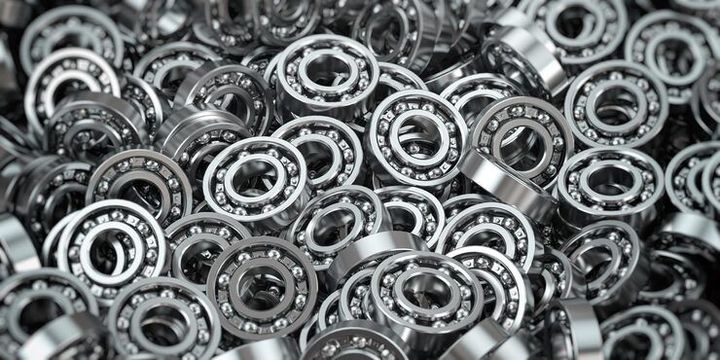
Industrial Bearings Overview: Discover Different Types and Their Role in Modern Machinery
Industrial bearings are essential mechanical components used in machines to support rotating or moving parts. They help reduce friction, maintain alignment, and allow machinery to operate smoothly.
From manufacturing plants and automotive equipment to wind turbines and industrial robots, bearings play an important role in modern engineering.
Understanding industrial bearings, their different types, applications, and working principles helps explain how modern machinery achieves reliable movement and operational efficiency. Developments in materials, lubrication, sensor technology, and predictive maintenance are also changing how industrial bearing systems are designed and monitored.
Context
Industrial bearings are mechanical components designed to support loads and control movement between two machine parts. Their primary purpose is to reduce friction while allowing shafts, wheels, gears, and other components to rotate or move with minimal resistance.
Bearings are commonly installed between stationary and moving machine components. They help distribute applied forces and maintain the correct position of rotating shafts. Without suitable bearings, machinery may experience excessive friction, heat generation, vibration, and premature component damage.
Industrial bearings generally operate under different loading conditions. These include radial loads, which act perpendicular to the shaft, and axial loads, which act along the shaft.
The main categories of industrial bearings include:
Different Types of Industrial Bearings
Bearing Type | Main Function | Common Applications |
|---|---|---|
Ball Bearings | Support radial and moderate axial loads | Electric motors and pumps |
Roller Bearings | Support heavier loads | Industrial machinery |
Tapered Roller Bearings | Handle combined radial and axial loads | Automotive systems |
Needle Bearings | Support loads in compact spaces | Gearboxes and transmissions |
Thrust Bearings | Support axial loads | Heavy rotating equipment |
Spherical Bearings | Accommodate misalignment | Mining and construction machinery |
Plain Bearings | Support sliding movement | Hydraulic equipment |
Each bearing type has specific operating characteristics. Selecting the appropriate design depends on load capacity, rotational speed, operating temperature, available space, and environmental conditions.
How Industrial Bearings Work
Most industrial bearings use rolling elements or sliding surfaces to reduce friction between moving components.
Rolling bearings contain balls or rollers positioned between inner and outer rings. These elements distribute loads and reduce direct contact between surfaces.
Plain bearings operate differently. They support movement through sliding contact, often using lubrication to separate the moving surfaces and reduce wear.
The correct bearing arrangement helps maintain shaft alignment, control vibration, and support consistent machine operation.
Importance
Industrial bearings are important because they influence machinery performance, operational reliability, and equipment lifespan. They are used across numerous industries where controlled mechanical movement is necessary.
In manufacturing facilities, bearings support conveyor systems, production equipment, electric motors, and automated machinery. In transportation, they are found in vehicle wheels, engines, transmissions, and railway systems.
Their importance can be understood through several factors.
Friction reduction: Bearings reduce resistance between moving machine components.
Load distribution: They support radial and axial forces during operation.
Equipment stability: Proper bearing arrangements help maintain shaft alignment.
Heat management: Reduced friction can help limit unwanted heat generation.
Operational reliability: Appropriate bearing selection and maintenance help reduce unexpected equipment failures.
Energy efficiency: Lower mechanical resistance can contribute to improved energy performance.
Industrial bearings also affect maintenance planning. Damaged or incorrectly installed bearings can create vibration, noise, temperature increases, and equipment downtime.
Industries such as automotive manufacturing, aerospace, mining, agriculture, renewable energy, and food processing depend on bearing technology for different mechanical requirements.
For example, wind turbines use specialized bearings to support rotating shafts under changing loads and environmental conditions. Mining equipment requires robust bearing arrangements capable of operating under heavy loads, dust, and vibration.
Recent Updates
Industrial bearing technology continues to develop as manufacturers and industrial operators focus on durability, precision, energy efficiency, and equipment monitoring.
Several developments are influencing the industry.
1. Smart bearing technology
Modern bearing systems can incorporate sensors that monitor temperature, vibration, speed, and operating conditions. These measurements help maintenance teams identify unusual changes before they develop into major equipment problems.
2. Predictive maintenance
Predictive maintenance uses equipment data to estimate when maintenance may be necessary. Bearing condition monitoring systems can help identify early signs of wear, lubrication problems, and mechanical imbalance.
3. Advanced bearing materials
Ceramic rolling elements, advanced steel alloys, and specialized coatings are used in applications requiring particular combinations of strength, temperature resistance, and reduced friction.
4. Improved lubrication systems
Modern lubrication technologies include automatic lubrication equipment, specialized synthetic lubricants, and condition-based lubrication practices. These developments help maintain suitable lubrication conditions in demanding industrial environments.
5. Energy-efficient bearing designs
Bearing manufacturers continue to develop designs that reduce friction and improve mechanical performance. Optimized internal geometry, surface finishing, and sealing arrangements can influence energy consumption and operating life.
6. Digital monitoring and automation
Industrial Internet of Things (IIoT) platforms allow bearing monitoring systems to share operating information with centralized equipment management platforms. This supports data-based maintenance decisions.
These developments are particularly relevant to automated factories, high-speed production systems, electric vehicles, and renewable energy installations.
Laws or Policies
Industrial bearings are influenced by engineering standards, workplace safety requirements, environmental regulations, and product quality guidelines. The specific rules depend on the country, industry, and equipment application.
Several international standards organizations provide technical guidance for bearing design, testing, dimensions, and performance.
Organization or Standard | Main Area | Relevance |
|---|---|---|
ISO | International engineering standards | Bearing dimensions and technical specifications |
ANSI | American national standards | Engineering and dimensional practices |
ABMA | Bearing industry standards | Bearing terminology and technical requirements |
ASTM International | Material testing standards | Material properties and testing methods |
IEC | Electrical equipment standards | Requirements relevant to electrical machinery |
In India, industrial bearing applications may also be affected by the following regulatory frameworks:
Bureau of Indian Standards (BIS): Provides Indian Standards relevant to engineering products and industrial applications.
Factories Act, 1948: Established workplace health and safety requirements for factories, subject to applicable legal changes and state provisions.
Occupational Safety, Health and Working Conditions Code, 2020: Provides a framework for workplace safety and health requirements, subject to its implementation and applicable rules.
Environmental regulations: Industrial facilities must follow applicable pollution control and environmental requirements.
Manufacturers and industrial operators should consult current standards and applicable national regulations before selecting or installing bearing systems.
Tools and Resources
Various technical resources help engineers, maintenance professionals, students, and equipment operators understand industrial bearings and their applications.
The following resources provide useful technical information.
Tool or Resource | Main Purpose |
|---|---|
SKF Bearing Calculator | Bearing selection and engineering calculations |
Schaeffler medias | Bearing product information and technical data |
NSK Technical Resources | Bearing specifications and engineering knowledge |
Timken Engineering Resources | Bearing design and application information |
ISO Standards Catalogue | International engineering standards |
NIST Engineering Resources | Measurement and technical information |
CAD Software | Bearing models and mechanical design |
Vibration Analysis Tools | Monitoring bearing operating conditions |
Useful engineering calculations include:
Bearing load calculations.
Basic rating life calculations.
Rotational speed assessment.
Lubrication interval estimation.
Shaft alignment measurements.
Operating temperature monitoring.
One commonly used bearing life equation is:
Where:
\(L_{10}\) = Basic rating life in millions of revolutions.
\(C\) = Basic dynamic load rating.
\(P\) = Equivalent dynamic bearing load.
\(p\) = Life exponent, typically 3 for ball bearings and 10/3 for roller bearings.
This equation provides an estimate of bearing fatigue life under specified operating conditions. Actual performance can vary because of lubrication, contamination, installation, and operating conditions.
FAQs
1. What are industrial bearings?
Industrial bearings are mechanical components that support rotating or moving machine parts. They reduce friction, distribute loads, and help maintain smooth mechanical movement.
2. What are the most common types of industrial bearings?
Common types include ball bearings, cylindrical roller bearings, tapered roller bearings, needle bearings, thrust bearings, and spherical roller bearings.
3. What industries use industrial bearings?
Industrial bearings are used in automotive manufacturing, aerospace, mining, agriculture, construction, renewable energy, food processing, and general manufacturing.
4. How can bearing performance be monitored?
Bearing performance can be monitored through vibration analysis, temperature measurements, noise inspection, lubrication checks, and sensor-based condition monitoring systems.
5. What factors affect industrial bearing lifespan?
Bearing lifespan depends on several factors, including applied loads, rotational speed, lubrication quality, operating temperature, contamination, installation accuracy, and maintenance practices.
Conclusion
Industrial bearings are fundamental components in modern machinery because they support movement, reduce friction, and distribute mechanical loads. Different bearing types are designed for specific operating conditions, making correct selection important for equipment performance and reliability.
Technological developments such as smart sensors, advanced materials, improved lubrication, and predictive maintenance are creating new possibilities for industrial bearing applications. Understanding these developments helps engineers and industrial professionals make informed decisions about machinery design and maintenance.
As industrial automation and precision manufacturing continue to develop, bearing technology will remain an important part of mechanical engineering. Proper installation, regular inspection, and suitable operating conditions will continue to influence bearing performance across different industries.