Meshy AI Explore Guide to AI 3D Modeling and Creative Design
Meshy AI is an artificial intelligence platform designed to help users create three-dimensional (3D) models from text descriptions and images. It supports digital creativity by making certain modeling tasks more accessible to beginners, designers, artists, educators, and developers.
AI 3D modeling combines natural-language instructions, image interpretation, and automated geometry generation to help transform creative ideas into digital objects.
This Meshy AI explore guide explains how AI-powered 3D modeling works, why it matters, and how it fits into modern creative workflows. It also covers recent developments, relevant laws and policies, practical tools, and common questions about generating, editing, and using AI-created 3D assets responsibly.
Context
Meshy AI is a generative AI platform focused on creating 3D content. Traditional 3D modeling often requires knowledge of geometry, digital sculpting, materials, lighting, and texture mapping. AI-assisted tools can simplify parts of this process by interpreting written prompts or visual references and generating an initial model for further refinement.
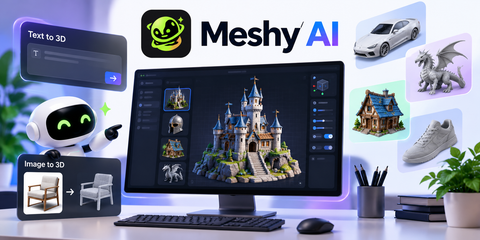
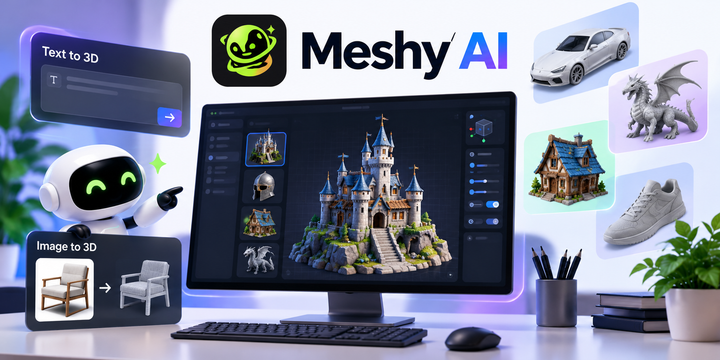
Users can describe an object in ordinary language, provide an image, or combine available generation methods to develop a digital representation. Depending on the selected features and model version, the platform can support text-to-3D generation, image-to-3D conversion, texture creation, and related asset preparation tasks.
The main purpose is to shorten the distance between an idea and an initial 3D concept. However, generated results may require manual adjustments before they are suitable for animation, engineering visualization, interactive applications, or manufacturing workflows.
AI-generated models generally contain several important elements:
Geometry, which defines an object's three-dimensional shape.
Materials and textures, which influence surface appearance.
Mesh topology, which describes how vertices, edges, and faces form a model.
Export formats, which determine compatibility with other digital tools.
Understanding these elements helps users evaluate whether a generated model meets the requirements of a particular project.
Importance
AI 3D modeling matters because it can reduce the technical barriers involved in developing digital objects. People who have limited modeling experience can explore concepts visually, while experienced artists can use generated models as starting points for detailed production work.
In game development, AI-generated assets may help with early environment concepts, props, and character exploration. In education, instructors can use 3D objects to explain shapes, structures, and spatial relationships. Product designers can develop visual concepts, while animation teams can investigate different artistic directions before committing to detailed modeling.
The technology may also support architectural visualization, virtual environments, digital storytelling, and augmented reality projects. Its usefulness depends on the quality of the output and the technical requirements of the intended application.
Several factors determine whether an AI-generated model is practical:
Shape accuracy and visual consistency.
Suitable polygon count and mesh structure.
Texture quality and material compatibility.
Correct scale, orientation, and proportions.
Compatibility with the target software or platform.
AI-generated geometry is not automatically suitable for every task. A visually convincing object may still have unsuitable topology, intersecting surfaces, or inaccurate dimensions. Engineering, medical, and other precision-sensitive applications may require specialist modeling and independent verification.
Recent Updates
AI 3D modeling continues to develop through improvements in geometry reconstruction, texture generation, animation, and integration with digital production tools. Meshy's official documentation describes capabilities such as text-to-3D generation, image-to-3D conversion, AI texturing, animation, and export integrations.
One notable development is the Meshy 7 generation model, introduced in 2026. The platform's documentation identifies improvements in image-based reconstruction and model detail. Multi-view inputs can also help users provide additional visual information when a single image does not adequately describe an object's shape.
Current developments across AI 3D design include:
Better alignment between reference images and generated geometry.
Automated rigging and animation for supported characters.
More detailed physically based rendering (PBR) textures.
Tools for adjusting mesh complexity for different applications.
Integration with game engines, 3D editors, and printing workflows.
These developments can make digital asset creation more accessible, but generated objects still need inspection. Small details, hidden surfaces, proportions, and mesh structure may differ from the original reference. Users should test exported files in their intended software before incorporating them into a final project.
Laws or Policies
AI-generated 3D models can raise questions about copyright, privacy, intellectual property, and responsible use. The relevant rules depend on the creator's location, the intended use, the source material, and the terms governing the platform.
In the United States, the U.S. Copyright Office explained in its January 2025 report that AI-generated material may qualify for copyright protection when a human contributes sufficient original expression. Providing prompts alone does not automatically establish copyright protection for the resulting output. Human-authored modifications or creative arrangements may receive protection when they meet the applicable legal standards.
In the European Union, the AI Act introduces transparency requirements for certain AI-generated content. Article 50's applicable transparency provisions begin applying on 2 August 2026, with a limited transition period for specified marking obligations involving certain systems already on the market. The exact obligations depend on the role of the provider or deployer and the type of content or system involved.
People using Meshy AI should consider these practical precautions:
Use reference images that they created or are authorized to use.
Review the platform's current terms, output rights, and attribution requirements.
Avoid reproducing protected characters, logos, or designs without appropriate authorization.
Obtain permission before using identifiable personal images in ways that could affect privacy.
Check applicable rules before distributing AI-generated assets or incorporating them into commercial projects.
These points are general educational guidance rather than legal advice. Requirements can differ across countries and change as legislation develops.
Tools and Resources
Meshy AI can be used alongside established 3D software and learning resources. Choosing the right combination depends on whether the objective is concept development, detailed modeling, animation, game production, or physical fabrication.
Tool or resource | Main purpose |
|---|---|
Meshy AI | Generate 3D models from text and images |
Blender | Edit meshes, sculpt, render, and animate objects |
Unity | Develop interactive applications and games |
Unreal Engine | Build real-time 3D environments |
Autodesk Maya | Create and animate detailed digital assets |
Meshy documentation | Learn generation settings and export workflows |
U.S. Copyright Office | Understand copyright principles for AI outputs |
European Commission AI Act resources | Review relevant European AI transparency rules |
A practical beginner's workflow starts with a clear idea and a simple prompt. For example, describing a small wooden chair with four legs, a curved backrest, and visible wood grain provides more useful direction than requesting a generic furniture model.
Next, review the generated shape from multiple angles. Adjust the prompt or reference image when the result differs from the intended design. After generation, import the model into a 3D editor to inspect its topology, materials, dimensions, and overall quality.
Finally, export the asset in a format supported by the target application. Common formats include OBJ, FBX, GLB, and STL, although their capabilities differ. For example, STL is commonly used for 3D printing geometry, while FBX and GLB are frequently used in digital content and interactive workflows. Verify texture support, scale, and file compatibility before completing the project.
FAQs
1. What is Meshy AI used for?
Meshy AI helps users generate textured 3D models from written descriptions and images. It also supports selected texturing, rigging, animation, and asset preparation tasks.
2. Can beginners use Meshy AI for 3D modeling?
Yes. Its prompt-based generation tools allow beginners to explore 3D creation without mastering traditional modeling techniques first. Learning basic geometry and texture concepts helps improve results.
3. Can Meshy AI models be used in games?
Generated models can be imported into compatible game development environments. However, developers should check polygon counts, textures, scale, collision requirements, and performance before using them in a game.
4. Are Meshy AI outputs automatically protected by copyright?
No. Copyright protection depends on applicable law and the level of qualifying human creative contribution. Users should also consider third-party intellectual property and the platform's usage terms.
5. Does Meshy AI replace traditional 3D modeling software?
Not entirely. AI can accelerate initial generation, but traditional software remains valuable for precise editing, topology correction, advanced animation, and production-specific requirements.
Conclusion
Meshy AI illustrates how artificial intelligence is changing 3D modeling and creative design. By transforming text descriptions and reference images into digital objects, it can help beginners explore new ideas and experienced creators develop initial concepts more efficiently.
Its practical value depends on model quality, technical compatibility, and the user's ability to evaluate generated results. Understanding intellectual property rules, refining prompts, and checking exported assets are important steps toward responsible AI-assisted creativity.
For anyone exploring AI 3D modeling, a useful starting point is to create a simple object, inspect the result, and practice refining it in a conventional 3D editor. This approach builds familiarity with both generative tools and established digital design techniques.