Industrial Flow Measurement Beginner’s Guide to Sensors, Meters, and Measurement Basics
Industrial flow measurement is the process of determining how much liquid, gas, steam, or other material moves through a pipe or channel over a specific period. It plays an important role in manufacturing, water treatment, chemical processing, energy production, food processing, and many other industrial activities.
Understanding industrial flow measurement helps engineers, technicians, and plant operators monitor processes, maintain consistent production conditions, and identify unusual changes in fluid movement. Learning about flow sensors, flow meters, measurement units, and calibration provides a useful foundation for understanding modern industrial systems.
Context – Understanding Industrial Flow Measurement
Industrial flow measurement refers to the techniques and instruments used to determine the movement of fluids through industrial systems. These instruments measure either volumetric flow rate, which describes the volume passing through a point over time, or mass flow rate, which measures the mass passing through that point over time.
For example, a water treatment facility may monitor the volume of water moving through a pipeline, while a chemical processing plant may need to measure the mass of ingredients entering a production vessel.
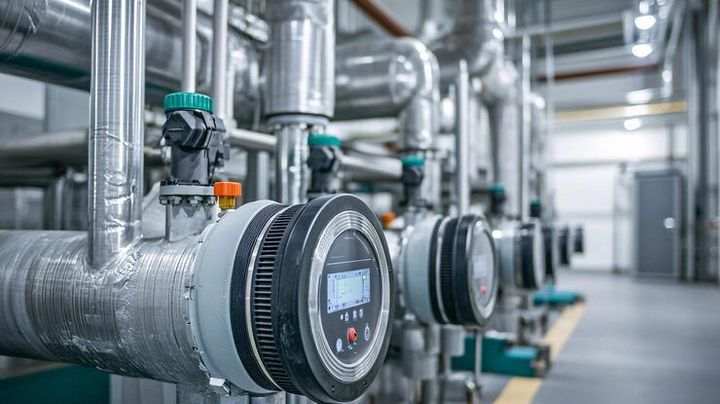
Flow measurement systems generally include a sensor or primary measuring element, electronic components, and a display or control system. Depending on the technology, an instrument may measure flow directly or calculate it from related properties such as pressure difference, fluid velocity, or changes in heat transfer.
Common measurement units include:
Liters per minute (L/min)
Cubic meters per hour (m³/h)
Gallons per minute (GPM)
Kilograms per hour (kg/h)
Standard cubic meters per hour (Sm³/h), under specified reference conditions
The correct unit depends on the fluid, the industrial process, and the measurement objective.
Common Types of Flow Meters
Different flow meters work with different physical principles. Selecting an appropriate instrument requires knowledge of the fluid's properties, operating conditions, and measurement requirements.
Flow meter type | Working principle | Common applications |
|---|---|---|
Electromagnetic | Uses electromagnetic induction | Water and conductive liquids |
Ultrasonic | Uses sound-wave transmission or Doppler effects | Water, wastewater, and selected gases |
Coriolis | Measures effects associated with mass flow | Chemicals, liquids, and selected gases |
Differential pressure | Measures pressure differences across a restriction | Steam, gases, and liquids |
Turbine | Measures rotor rotation caused by fluid movement | Clean liquids and selected gases |
Vortex | Detects vortices created by an obstruction | Steam, gases, and liquids |
Thermal mass | Uses heat transfer to determine mass flow | Industrial gases and compressed air |
Positive displacement | Measures repeated, defined fluid volumes | Oils and other compatible liquids |
Each technology has limitations. For instance, electromagnetic meters generally require electrically conductive liquids, while turbine meters can be sensitive to fluid cleanliness, viscosity, and flow profile.
Importance – Why Industrial Flow Measurement Matters
Accurate flow measurement supports safe, consistent, and efficient industrial operations. Many processes depend on maintaining a defined quantity of material within a particular time interval. Incorrect readings can affect product quality, equipment performance, resource use, and process control.
In water treatment, flow data helps operators understand distribution and treatment volumes. In chemical manufacturing, measurement supports the controlled delivery of ingredients. In power generation, monitoring steam and other fluids helps operators evaluate process conditions.
Flow measurement also helps identify potential problems, including unexpected consumption, blockages, leaks, and changes in operating conditions. However, a flow meter alone cannot identify every underlying issue. Readings must be interpreted alongside pressure, temperature, equipment status, and other relevant information.
Several groups rely on flow measurement data:
Process engineers who design and optimize industrial systems.
Instrumentation technicians who install, inspect, and calibrate instruments.
Plant operators who monitor production conditions.
Quality teams that verify process consistency.
Maintenance teams that investigate abnormal readings.
Measurement accuracy depends on several factors, including instrument selection, installation quality, fluid characteristics, calibration, and operating conditions. A technically suitable meter can still produce unreliable readings if installed incorrectly or operated outside its specified range.
Recent Updates – Trends in Industrial Flow Measurement
Industrial flow measurement continues to develop through digital instrumentation, improved diagnostics, and integration with automated control systems. These developments help plants collect and interpret process information more effectively.
One important trend is the use of smart flow meters. Some modern instruments can report diagnostic information, detect certain abnormal conditions, and communicate measurement data through industrial networks. These capabilities can help technicians investigate problems before they cause significant process interruptions.
Another development is the growing use of non-invasive ultrasonic measurement. Clamp-on ultrasonic meters can measure flow from outside a compatible pipe, reducing the need to interrupt the process or modify the pipework. Their performance depends on factors such as pipe material, wall condition, fluid properties, and installation quality.
Industrial facilities are also connecting flow instruments to supervisory control and data acquisition (SCADA) systems and distributed control systems (DCS). This allows operators to view flow information alongside other process measurements.
Other notable developments include:
Wireless communication for selected monitoring applications.
Digital records that support instrument maintenance and calibration.
Improved diagnostics for detecting measurement irregularities.
Integration with industrial data platforms for process analysis.
Greater attention to energy and water monitoring.
Digital technology does not eliminate the need for sound engineering practices. Plants must still verify instrument performance, protect industrial networks, and ensure that measurement data is interpreted correctly.
Laws or Policies – Standards and Regulatory Considerations
Industrial flow measurement may be affected by technical standards, environmental requirements, workplace safety rules, and industry-specific regulations. The applicable requirements depend on the country, fluid, installation, and purpose of the measurement.
International standards from the International Organization for Standardization (ISO) address aspects of flow measurement, including methods for measuring fluid flow in closed conduits. The International Electrotechnical Commission (IEC) publishes standards relevant to electrical and electronic instrumentation. These documents can help organizations establish consistent measurement and testing practices.
The International Organization of Legal Metrology (OIML) develops recommendations for measurement instruments used in regulated applications. Legal metrology requirements are particularly relevant when measurements determine commercial quantities or other legally controlled values.
In the United States, the Occupational Safety and Health Administration (OSHA) establishes workplace safety requirements relevant to industrial environments. Environmental regulations may also require facilities to monitor water discharge, emissions, or other process quantities.
In India, industrial facilities may need to consider applicable requirements under the Legal Metrology Act, 2009, environmental rules, and relevant technical standards. The specific obligations depend on the application and the instrument's intended use.
Organizations should review the following before selecting or operating a flow measurement system:
Applicable national and industry standards.
Required accuracy and measurement traceability.
Hazardous-area requirements, where relevant.
Environmental monitoring and reporting obligations.
Calibration records and inspection procedures.
Standards and regulations can change, so facilities should consult current official documents and qualified technical personnel when determining compliance.
Tools and Resources – Learning and Applying Flow Measurement
Several technical resources can help beginners understand flow meter operation, instrument selection, and measurement calculations.
The National Institute of Standards and Technology (NIST) provides information about measurement science, calibration, and metrology. ISO and IEC publications help readers understand relevant technical standards. Instrument manufacturers also publish technical manuals, installation guides, and product-specific performance specifications.
Useful resources include:
Flow rate calculators for converting between volumetric and mass flow units when the required fluid properties are known.
Pipe flow calculators for estimating velocity from flow rate and internal pipe diameter.
Calibration records for documenting instrument checks, results, and adjustments.
Instrument selection worksheets covering fluid type, pressure, temperature, flow range, and required accuracy.
SCADA and process-control documentation for understanding how measurements are displayed and recorded.
A basic calculation illustrates the relationship between volumetric flow rate, average fluid velocity, and pipe cross-sectional area:
Here, \(Q\) is volumetric flow rate, \(A\) is the pipe's internal cross-sectional area, and \(v\) is the average fluid velocity.
For example, if the internal cross-sectional area is 0.01 m² and the average fluid velocity is 2 m/s, the volumetric flow rate is 0.02 m³/s, equivalent to 72 m³/h.
This calculation assumes a suitable average velocity across the pipe section and consistent units. Actual flow meter readings may require additional corrections or calculations, depending on the measurement technology and operating conditions.
FAQs – Industrial Flow Measurement Basics
1. What is industrial flow measurement?
Industrial flow measurement determines the volume or mass of a fluid moving through a pipe or channel over time. It supports process monitoring, quality control, and industrial automation.
2. What is the difference between a flow sensor and a flow meter?
A flow sensor detects a physical property associated with fluid movement. A flow meter is an instrument or assembly that measures and presents flow information, often incorporating a sensor and signal-processing electronics.
3. Which flow meter is suitable for water?
The appropriate meter depends on water quality, pipe size, flow range, installation conditions, and accuracy requirements. Electromagnetic, ultrasonic, turbine, and differential-pressure meters may be suitable for different water applications.
4. How often should industrial flow meters be calibrated?
Calibration intervals depend on the instrument manufacturer's recommendations, operating environment, required measurement accuracy, applicable regulations, and historical performance. Critical applications may require more frequent verification.
5. Why do industrial flow meters produce inaccurate readings?
Possible causes include incorrect installation, deposits or obstructions, changing fluid properties, air bubbles, electrical interference, incorrect configuration, and calibration drift. Troubleshooting should consider the instrument's operating principle and installation conditions.
Conclusion – Building Knowledge of Flow Measurement
Industrial flow measurement is an essential part of modern process monitoring. Understanding flow sensors, meter types, measurement units, calibration, and installation requirements helps engineers and operators interpret process data and select suitable instruments.
Choosing a flow meter requires more than comparing measurement technologies. The fluid's characteristics, operating conditions, accuracy requirements, maintenance needs, and applicable standards must all be considered.
A practical starting point is to identify the fluid, determine the required measurement range, review the available installation conditions, and consult technical documentation. These steps help establish a sound foundation for reliable industrial flow measurement.